WHY BESTHISTORY EXISTS
I built BestHistory because I was afraid to close tabs.
Not because tabs themselves mattered, but because I knew what would happen next.
A few days later I would remember that I had found a useful website — a PDF tool, an AI service, a design reference, a small utility — and I would have no idea what it was called.
I would open Chrome history and see thousands of page titles. I might remember roughly what the site did, but not the exact title, domain, or date. So instead of trusting history, I started keeping things open.
Pinned tabs. Bookmarks. Extra windows. More tabs that I was “going to come back to.”
Eventually I had several different systems for not losing websites — and still couldn’t reliably find the one I wanted.
I didn’t need a prettier history list
The important realization was that I usually do not remember a page the way Chrome stores it.
I might forget the page title and date completely, but I often remember something like:
- “the website where I converted a PDF into images,”
- “that AI site I tried a few months ago,”
- “the tool I used while working on that project,”
- or simply “I remember what kind of website it was.”
So the first idea behind BestHistory was simple:
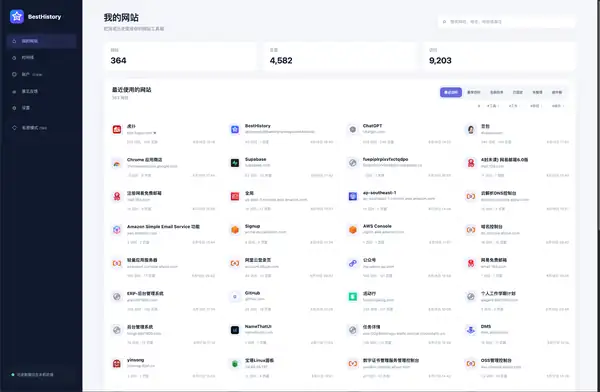
show me websites first, then let me open the individual pages underneath them.
That one change made browser history feel much closer to the way I actually remember things.
Then I wanted to leave clues for my future self
A website’s official name is not always meaningful to me.
So BestHistory lets me attach my own tags and notes. Sometimes one sentence is enough:
“The site I used to turn PDFs into images.”
Months later, that sentence can be more useful than the site’s actual title.
The timeline also groups consecutive pages from the same website together, because I care more about the browsing journey than seeing the same domain repeated twenty times in a row.
AI should help recall — not take over the history database
When I added AI Recall, I did not want the solution to become “upload your complete browser history to an AI service.”
The goal is narrower: when I deliberately ask for help with a fuzzy memory, AI can help turn that memory into better search clues, and BestHistory can verify those clues against local history.
That is also why BestHistory remains local-first. The full browsing-history database, Private Mode database, and backup files stay on the device by default.
Private history is still history you may want to remember
There is another awkward category of browsing history: things you may want to find again, but do not want sitting openly beside normal history.
Private Mode was built for that. Selected history can be kept separately and encrypted locally. If the user explicitly allows BestHistory to run in incognito mode, those visits can also be remembered privately instead of disappearing when the incognito window closes.
What I want BestHistory to become
I do not want it to become a giant browser suite.
I want it to remain very good at one problem:
helping you recover a website you once used, even when your memory of it is incomplete.
If BestHistory eventually means that people feel comfortable closing tabs instead of keeping them open “just in case,” then it is doing what I built it to do.
BestHistory v1.0 is the first version I feel comfortable putting in front of more people. It is still a personal product, and I expect it to change based on real use.
If it solves the same problem for you, I would genuinely like to hear what works, what does not, and what you wish it could remember better.